American Ninja Warrior Premiers June 1st!

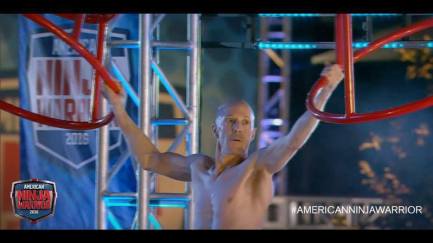
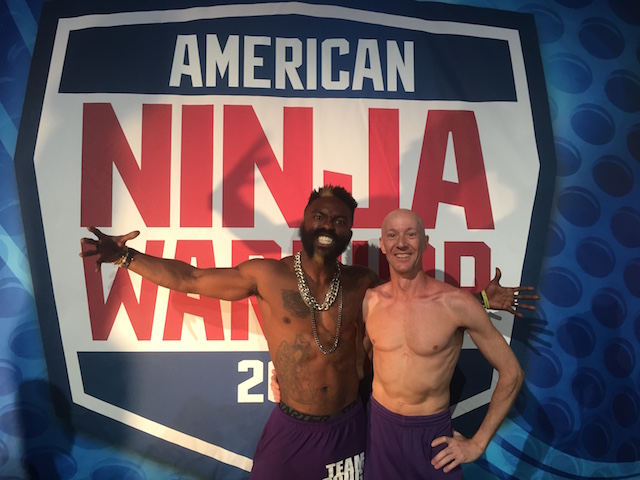
Bootie CothranFriends, here comes season 8 of American Ninja Warrior! On Wednesday, June 1st at 8/7c., the season premier will be the Los Angeles region, and then on June 8th, the Atlanta region, where I competed, will air. Don’t miss it!

The first two weeks the show airs on Wednesdays, then moves to Mondays.

To get you warmed up, here’s a quick promo video for the new season, and a link to some of my photos from Atlanta.

Follow these official American Ninja Warrior social media accounts:
facebook: NBC American Ninja Warrior
Twitter: @nbcninjawarrior
Instagram: @nbcninjawarrior

Photos: American Ninja Warrior 8 – Atlanta

https://www.youtube.com/watch?v=l6rDr3mqTTk

Man vs Machine 2016

When it’s cold outside, it’s easy for most of us to just turn up the thermostat on the wall a few degrees if we need to. But many people in our community struggle to keep their homes warm, either because of financial hardship or because they live in an older home that is drafty and poorly insulated, making it inefficient and expensive to heat.

So on Saturday, February 27th at Noon, at the front lawn of First Baptist Church in Greenville, I will face off in a battle against a 20-ton hydraulic log splitter in our 3rd annual event to see who can split the most wood the fastest, all to help folks who need assistance heating their homes.  There will be great food, plenty of friends, and exciting competition.

Donations can be made in person at the event, or online at http://sustainingway.org/mvm.

Please share this post or the video below with your friends. I hope to see you there!
Bootie

Thanks to First Baptist Church of Greenville, Nicholtown Missionary Baptist Church, sustainingway.org and Osteen’s Coal and Wood in downtown Greenville.


A Look at “Bury My Heart at Wounded Knee” by Dee Brown

*I originally published this on my Facebook page in 2009 and wanted to include it here.

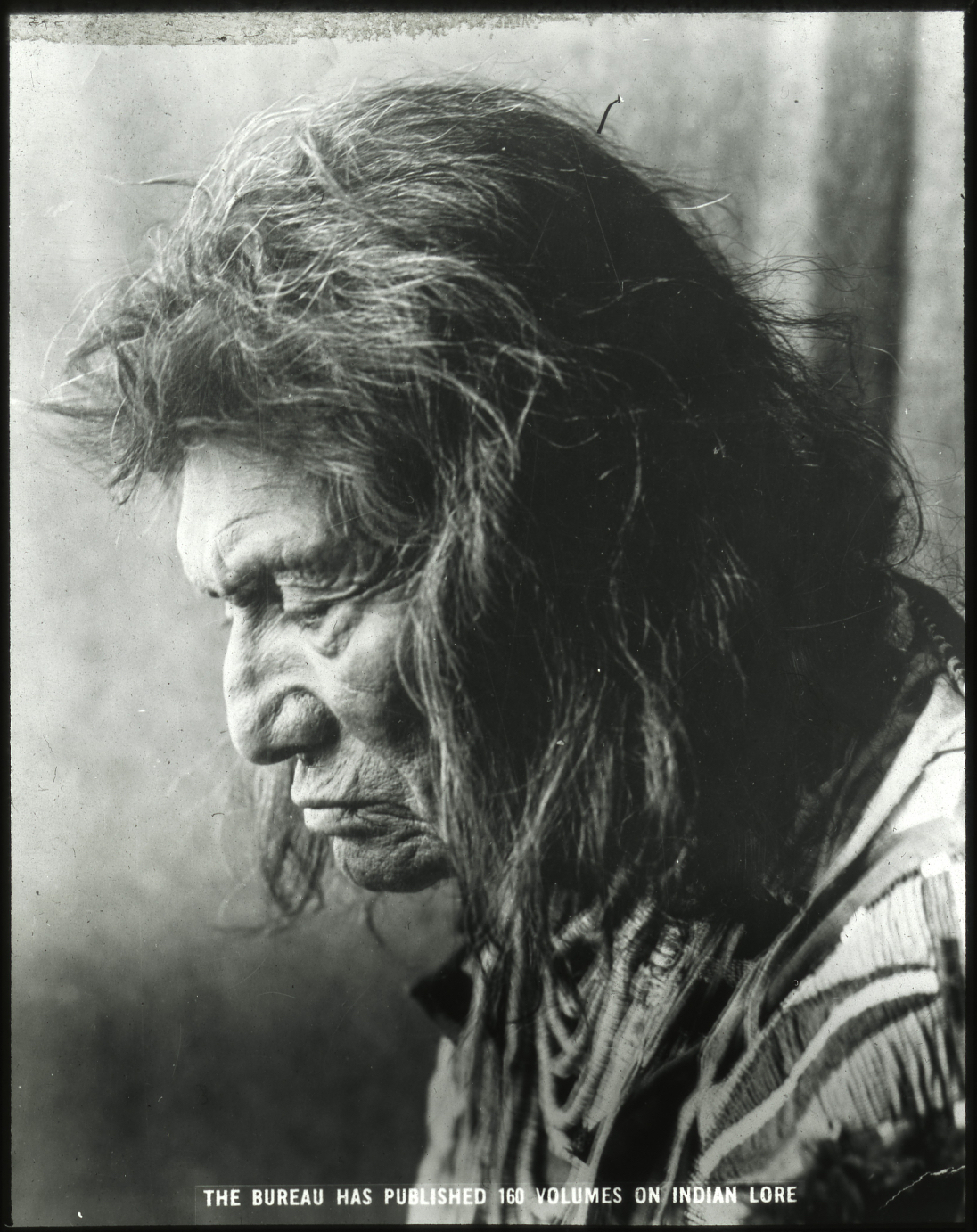
www.siarchives.si.edu. Acc. 12-492, Box 4; Portrait of an identified male. Label on slide: I-BAE 3.

http://www.siarchives.si.edu. Acc. 12-492, Box 4; Portrait of an identified male. Label on slide: I-BAE 3.

I recently finished reading Dee Brown’s book, “Bury My Heart at Wounded Knee”. If you are not familiar with it, it is the history of the American west from the Indian’s perspective using “council records, autobiographies, and firsthand descriptions” from various tribes as well as U.S. Congressional records. It opened my eyes to who the true savages were in the fight for the American west. I already knew the Indians got completely shafted but I didn’t know the scope of it.

It’s always different after hearing the other side to a story. As an admirer of the Indian perspective and way of life, it is discomforting to read, and I wish everyone living under the flag of the United States of America would read it.

If you don’t know the history of this era, here is the simple version: The “white’s” forcibly and systematically pushed the Indians off their lands and wiped out their way of life for the greed of money, land, gold and silver. And it did not matter to the Americans in the least if they trampled over another human being in the process (it actually took an 1879 court case, Standing Bear v. Crook, to determine if an Indian even qualified as a “person”). That is the easy version. Anyway, it makes me mad as hell and I wanted to recommend it.  And instead of just leaving it at that, I’m gonna blabber on about it some more and include some select quotes from the book. So if it interests you, please keep reading.

To understand their perspective, you must first understand the Indian. Christopher Columbus wrote these words about his experiences with Indians, taken from the very first page of the book:

“‘So tractable, so peaceable, are these people,’ Columbus wrote to the King and Queen of Spain, ‘that I swear to your Majesties there is not in the world a better nation. They love their neighbors as themselves, and their discourse is ever sweet and gentle, and accompanied with a smile; and though it is true that they are naked, yet their manners are decorous and praiseworthy.'” (p. 1)

In my mind the Indians had the ultimate life. They had their own little bit of heaven on earth. They experienced the joy of living in the middle of Nature, hand-in-hand with it, and in a culture that placed importance on treating others the way they would want to be treated. Those gentle, peaceful characteristics of the Indians to which Columbus referred stemmed directly from the importance they place on things like trust and honor – quite different than the predominant culture around us today. The Indian way of life is an example of integrity. Similar to the ancient oriental culture, the Indians’ code of honor and trust is more important than anything. To say one thing and do another is simply unacceptable.

“‘The Cheyennes do not break their word,’ One-Eye replied. ‘If they should do so, I would not care to live longer.'” (p. 77).

I was just about to suggest that the Indians were too trusting, but maybe there is a better way of saying that. To say the Indians were “too trusting” suggests they were somehow at fault when, in actuality, it was the white man’s greed and dishonor which was the sole source of the problem. Regardless, the Indians trusted the Americans at their word, even through their continued broken promises and treaties. That was the most frustrating part of this book, for me. Each time the Americans would come to the Indians to request more land or a new treaty, I kept wanting to step into the tent and say, “Don’t do it! Don’t trust them!!” Time after time, the Americans proved they were not to be trusted, but by the time the Indians finally realized this fact, there was nothing left to fight for and no one left to fight with. The American war machine successfully divided and conquered the Indians, destroying them and their peaceful way of life, all for the sake of money and power.

Unlike the white’s culture, the Indians’ way of life did not revolve around the want of material possessions and comforts. I think that is what I admire most. Likewise, they do not understand the concept of “owning” land.

“One does not sell the earth upon which the people walk.”
– Tashunka Witko (Crazy Horse) (p. 274)

They lived in harmony with the Earth, taking only what they needed to survive. The respect of Life and Nature is at their core. They were self-sufficient and perfectly content with their simple, peaceful way of life but the whites – too consumed by their greed to understand – felt it was their duty to “correct” and “civilize” the Indians for their own sake.

Personally, I think the Indians had it right. It’s ironic how our modern-day culture now strives to be “green” and respect the Earth, when the Indians were on top of this way of life centuries ago. It’s a shame that the early Americans were too focused on conquering them to actually learn anything from them. Hear this excerpt referencing Nathan Meeker, a government official complaining about the Utes band of Indians in Colorado in 1879:

“‘Their needs are so few that they do not wish to adopt civilized habits,’ Meeker complained to the commissioner of Indian Affairs. ‘What we call conveniences and comforts are not sufficiently valued by them to cause them to undertake to obtain them by their own efforts… the great majority look upon the white man’s ways with indifference and contempt.’ He proposed a course of action to correct this barbaric condition: first, take away the Utes’ hundreds of ponies so that they could not roam and hunt, replace the ponies with a few draft horses for plowing and hauling, and then as soon as the Utes were thus forced to abandon the hunt and remain near the agency, he would issue no more rations to those who would not work. ‘I shall cut every Indian down to the bare starvation point’, he wrote Colorado’s Senator Henry M. Teller, ‘if he will not work.'” (p. 374)

Over time the Indians were divided and moved from their native lands and herded into ever-shrinking reservations, often treated as no better than cattle. In meetings with government bureaucrats in Washington, Chief Joseph of the Nez Perces Indians pleaded his case for justice this way:

“I have heard talk and talk, but nothing is done. Good words do not last long unless they amount to something. Words do not pay for my dead people. They do not pay for my country, now overrun by white men… Good words will not give my people good health and stop them from dying. Good words will not get my people a home where they can live in peace and take care of themselves. I am tired of talk that comes to nothing. It makes my heart sick when I remember all the good words and broken promises… You might as well expect the rivers to run backward as that any man who was born a free man should be contented when penned up and denied liberty to go where he pleases… I have asked some of the great white chiefs where they get their authority to say to the Indian that he shall stay in one place, while he sees white men going where they please. They cannot tell me.” (p. 330)

“Gall,” a Hunkpapa war chief shared his perspective this way:

“We were born naked and have been taught to hunt and live on the game. You [Americans] tell us that we must learn to farm, live in one house, and take on your ways. Suppose the people living beyond the great sea should come and tell you that you must stop farming and kill your cattle, and take your houses and lands, what would you do? Would you not fight them?” (p.293)

And the Indians had no way to fight the propaganda war. The American perspective was that the Indians were nothing more than uncivilized savages, as that was what the local newspapers told them:

“‘It is too often the case,’ Crook said, ‘that border newspapers… disseminate all sorts of exaggerations and falsehoods about the Indians, which are copied in papers of high character and wide circulation, in other parts of the country, while the Indians’ side of the case is rarely ever heard. In this way the people at large get false ideas with reference to the matter. Then when the outbreak does come public attention is tuned to the Indians, their crimes and atrocities are alone condemned, while the persons whose injustice has driven them to this course escape scot-free and are the loudest in their denunciations. No one knows this fact better than the Indian, therefore he is excusable in seeing no justice in a government which only punishes him, while it allows the white man to plunder him as he pleases.” (p. 405)

Eventually the Indians lost their native lands, their way of life and their liberty. They were forced from their way of life and made to take on the selfish ways of the white man, relying on the government for rations since they could no longer hunt.

“I thought God intended us to live, but I was mistaken. God intends to give the country to the white people, and we are to die. It may be well; it may be well.” – Standing Bear (p.359)

The Indians never stood a chance. Their peaceful, trusting manner and primitive weapons was no match for the kind of power, marketing and weaponry money can buy or the greed that comes with it. What selfishness and “the love of money” did to the Indians and their way of life was nothing short of genocide.

I think it’s a powerful book and one every person should read. There is a lot more I want to get into, branching off into some deeper questions, but this note is too long already. I’ll post more another time. In the meantime, if you’re looking for reading material, consider Bury My Heart at Wounded Knee, by Dee Brown.

Peace,
Bootie
A Study of the Australian Gun Ban of 1996

In 1996, Australia experienced a mass shooting so devastating that they swiftly enacted a mandatory gun buyback program which took a vast majority of guns out of circulation. Many references are made to this legislation and its results, on both sides of the American gun debate. But as is the case with most news and statistics floating around on the Internet, you can seldom trust who has done their homework on the data, who has an agenda, or who is just making up numbers. As the old, wise saying goes, if you want something done right, do it yourself. So I did my own searching online and it didn’t take long for me to find a wealth of valuable, unbiased, and trustworthy information, direct from the Australian government.

I found a site (http://www.aic.gov.au/) run by the Australian Institute of Criminology, a department of the Australian government. They provide statistics and data on all crime in Australia, and the criteria are very customizable. The most popular fact quoted about the gun ban of 1996 is that Australia has not had a single mass shooting event since. That is undeniable fact (and certainly is good news) and, by itself, seems to indicate that the answer to violence is simply to remove guns from a society. Simple statistics like that play to our emotions and sound great, but they only scratch the surface of the larger picture. So let’s dig a little deeper and consider the following 6 charts:


The first chart below shows the actual number of homicides in Australia from 1993-2012. This data is not specific to guns, but any homicide, whether committed with a weapon or not. Since the 1996 gun ban, some years had slightly higher numbers, and some had slightly lower numbers, but they all hovered around the 300 mark. For a society with a gun ban in place, I would expect a dramatic decrease in homicides, but that did not happen. This data shows that the gun ban had little or no effect in deterring those with a desire to kill.

Australia Gun Ban Figure1

Figure 1. This data and its chart is available at http://www.aic.gov.au/.

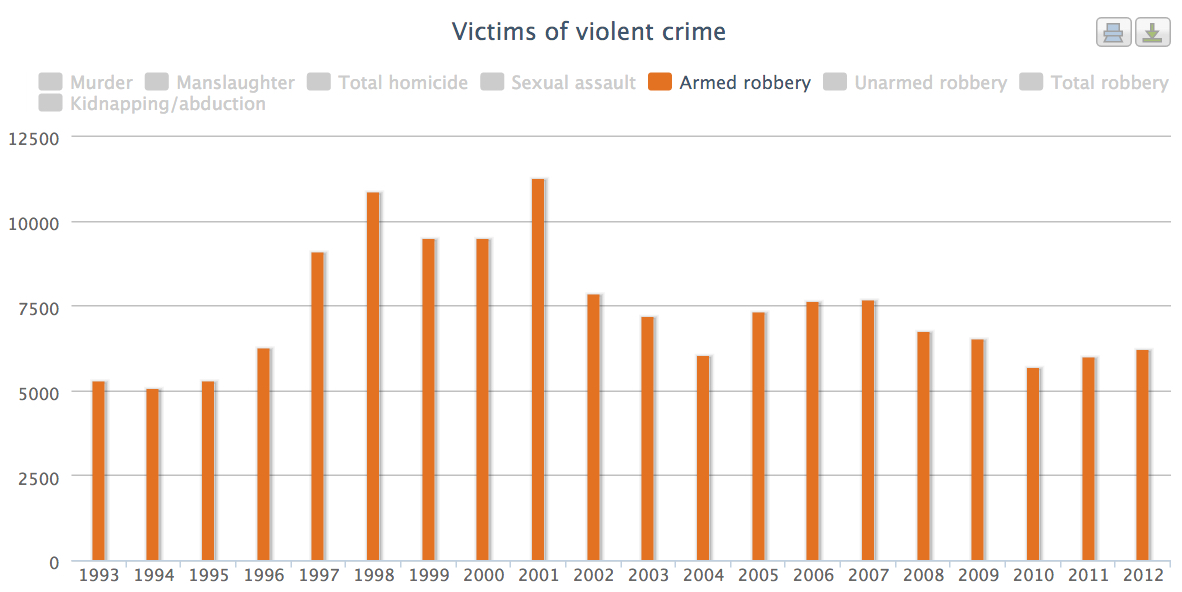
Let’s look at how the gun ban affected armed robberies in the chart below. After the 1996 ban, armed robberies did not decrease at all but actually increased, and by dramatic amounts, from 6,256 in 1996 to over 9,000 and 10,000 and 11,000 in the 5 years after the gun ban. This suggests that an unarmed, law abiding population makes for easier prey for criminals.

Australia Gun Ban Figure2

Figure 2.This data and its chart is available at http://www.aic.gov.au/.

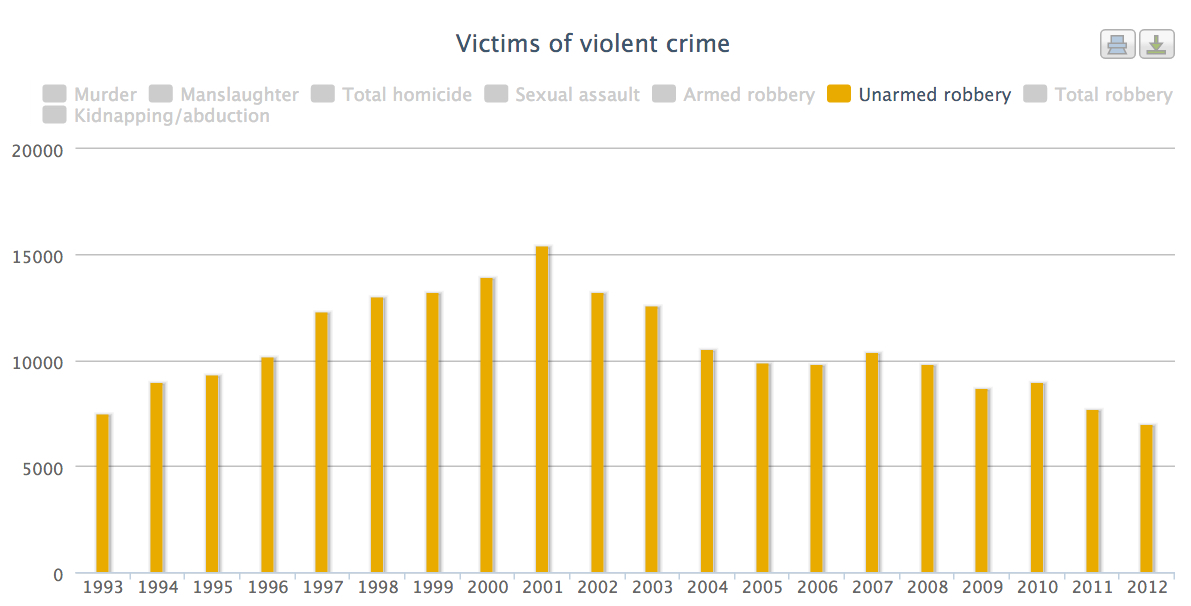
What about unarmed robbery? The chart below shows those numbers also rose dramatically after the gun ban, indicating that a criminal does not need a gun or any weapon to commit their desired crime. These numbers again suggest that criminal activity increases when the population is unarmed and unable to properly defend themselves.

Australia Gun Ban Figure3

Figure 3.This data and its chart is available at http://www.aic.gov.au/.

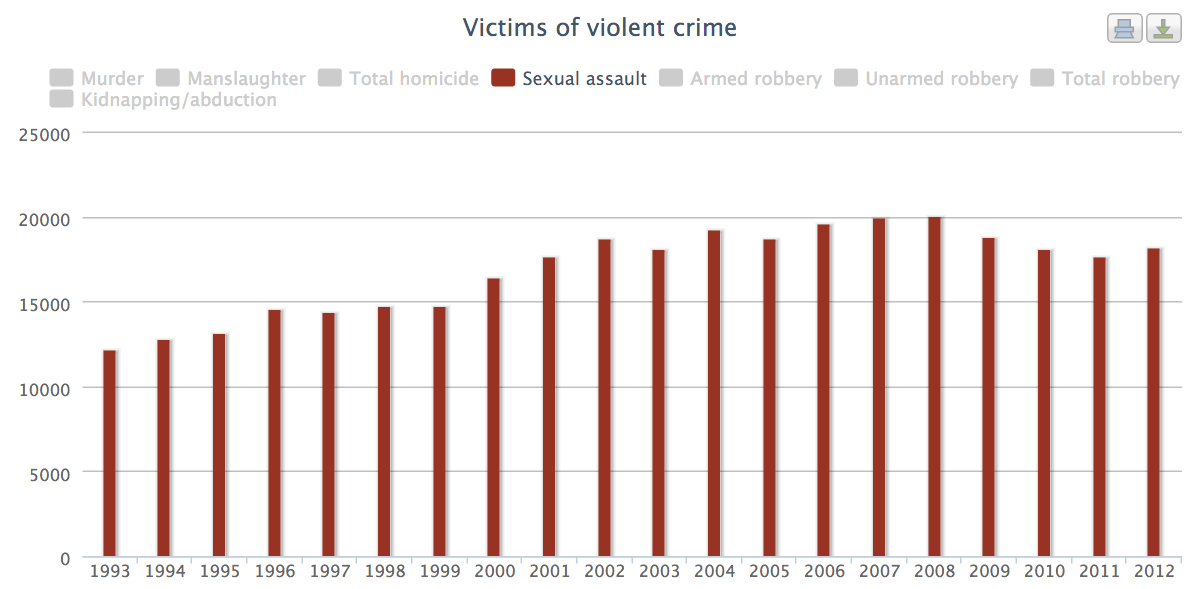
Let’s look at sexual assaults. The chart below shows that sexual assaults also increased after the 1996 gun ban, and again, suggest it is easier for criminals to assault someone when those victims aren’t allowed a weapon to protect themselves.

Australia Gun Ban Figure4

Figure 4.This data and its chart is available at http://www.aic.gov.au/.

The chart below combines all the data above into one chart showing total violent crime numbers of homicide, sexual assault and robbery. One might think, after a near total gun ban and confiscation in a society, that violent crime numbers would go down dramatically. I’m actually quite surprised that the numbers increased to this degree. By 2001, total violent crime numbers nearly DOUBLED from the years before the gun ban. Even worse, the total violent crime numbers have been higher EVERY year since the 1996 ban. EVERY YEAR.

Australia Gun Ban Figure5

Figure 5. This data is available at http://www.aic.gov.au/dataTools/facts/vicViolentCol.html. The site did not provide its own graphical bar chart representing these totals, so I compiled the numbers from the available data and created the chart.

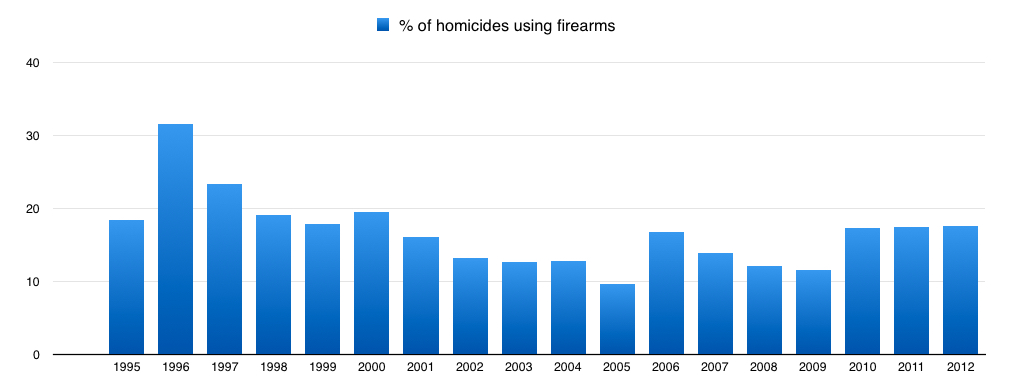
The last chart below shows the percentage of homicides where a firearm was used. 1996 was the largest year by far, which was the year the last mass killing happened and when the ban was proposed and instituted. Outside of that year, the usage of firearms remains relatively consistent, in the 15-20 percent range. With a few down years in between, the percentage of firearms used in homicides in 2010, 2011 and 2012 is virtually the same as it was in 1995, before the gun ban was put in place.

Australia Gun Ban Figure6

Figure 6. This data is available at http://www.aic.gov.au/dataTools/facts/weaponSpecified.html. The site did not provide its own  graphical bar chart representing these totals, so I used the available data and created the chart.

Australia Gun Ban Figure7One would imagine there would be some immediate or significant decrease in homicides and violent crime after guns are removed from a society, but the data from the Australian government does not support that. It’s great that there has never been another mass killing, but that is only a small part of a much larger picture.

The unfortunate fact of life is that there are some people in the world who will not hesitate to harm others for their own selfish gain. This is simple human behavior. It is not a matter of the number or type of weapons available in a society, but what kind of values are present in its people. A monastery or convent filled with military weapons would still remain peaceful because the people inside are peaceful. But when you remove the weapon from the hands of an angry and violent person, what you are left with is still an angry and violent person. The creativity of the human mind is unlimited in its ability to devise, plan and carry out violence, regardless of the availability of any one particular weapon.

No differently than having access to a fire extinguisher in your home that you never wish to need, we would be wise to prepare ourselves and our children for the dangers of the real world around us. It is foolish to simply hope it won’t happen to you or your loved ones, and equally foolish to rely solely on others (police) to always be there in an emergency to bail you out of a crisis.

I believe the best tools to combat violence in any society is a balanced approach of:
a) Kindness, respect, compassion, understanding and forgiveness, and
b) Learning how to defend yourself from those who don’t share those peaceful values.

Neither of those is complete without the other. Stay educated and stay safe. Peace.

Building the Library in Cange, Haiti

Cange, Haiti LibraryThis past March, I travelled to Cange, Haiti to learn about the small, community library there.  It’s a small, 1-room building with 2 walls of books, 6 computers, and many patrons.

The students I encountered in Haiti have a strong desire to learn. They appreciate the value and the power of education in a way that is foreign to me and my days in my school. In the evenings, as we walked through the walled-off complex, I was fascinated to see students sitting at the base of the lampposts, reading and studying there because there were no lights at home. In the mornings and afternoons I saw children and youth walking for miles beside the winding mountain roads to get to and from school. They want to learn so they can empower themselves. All they need is a space and some resources. An education is the best help anyone can give.

The good schools are brick and concrete.  Many others are nothing more than open shelters built from rough-sawn boards nailed together.  Chalkboards and desks are an extra treat.

They don’t have many resources, but 4 years ago this small, community library was started, and has quickly outgrown its space. Dr. Sara Mansbach works diligently with her organization, Partners in Literacy Haiti, to help secure books and resources for the library. She travels to Cange regularly and meets with the local leaders who are fully-involved in making the library a sustainable and successful part of the community. Together, we interviewed many of those community leaders as well as students and others who experience the benefits of the library first-hand.

The exciting news is that the land has now been donated for this purpose, and we are now focused on finding donations to begin construction on the new library. I hope you will learn about this project through the short videos below and consider how you might help make this new library a tool for change in the region and the world.

ACCESS THE VIDEOS HERE

DONATE HERE


Cornbread in a Cast-Iron Skillet Recipe

A recipe everybody should know.

Set oven to 400 degrees.
Put 1/4 cup vegetable shortening in the skillet and put it in the oven while it preheats.
Beat 2 large eggs, mix into 1-1/3 cups whole milk or buttermilk.
Mix the eggs and milk in with 2 cups self-rising cornmeal.
When the shortening is melted, take the skillet out of the oven, pour the shortening into the batter, mix it well, then pour it all back into the skillet.
Put the skillet back in the oven for 20 minutes.
Remove, and pour 1/4 cup of melted butter over the top.
Return it to the oven for another 5 minutes.

Remove, then gobble that stuff up!!

Granito de Mostaza

“Granito de Mostaza”
(aka The Mustard Seed Song, aka Let the Mountains Move)

I learned this song from my friends in Cuba, and loved it so much I wanted to record my own arrangement. I LOVE the groove of this song! Pardon my Spanish, please. The translation is: If you would have the faith of a seed of mustard, this, the Lord tells you: You could tell the mountains to move, move, move, and those mountains would move.”  I’m on guitars, bass, percussion and vocals. I hope you enjoy my arrangement below.

My association with this song came from my experience with the “Patio Projects” in Cuba, a successful and growing effort to help communities and individuals turn wasted spaces into gardens and growing spaces, providing food, medicine, and turning lives around in the process.

I’ve been there and seen it in person, and there’s a lot we can learn from them.  Learn more about the Patio Projects in this video.

Download from Amazon
Download from iTunes

Lyrics:

Si tuvieras fe como un granito de mostaza, eso lo dice el Señor

Tu le dirías a asea montaña, muévete, muévete

Y esa montaña se moverá, se moverá, se moverá

Se está moviendo ya
Esa montaña se moverá

Don’t Let Go


This song came out of my recent American Ninja Warrior adventure in Orlando. My favorite songs are the ones that end up writing themselves – they just sort of come out on their own, from somewhere inside, and this one was no different. I wasn’t trying to write a song at the time, I was just picking on my guitar one day in early summer and this groove started coming out, and then these lyrics started coming out, so I followed where it took me and this is what I ended up with.

It’s titled “Don’t Let Go”, and it offers a glimpse into what was going on in my mind as I was running the course, but it’s about more than just that. It’s about not letting go of our goals and dreams, being unafraid to fail, using those failures as motivation to overcome our obstacles, and about hanging onto whatever figurative “rope” you’re hanging onto in life for just a little longer.

100% of the proceeds of this song will go directly to support my ninja friend Kenneth Niemitalo and his wife, whose new baby girl is dealing with some expensive health issues, so please share this post, spend an easy dollar and let’s help a brother out!

This song is dedicated to the entire ninja community, and everyone out there who is reaching for their goal or hanging onto their rope. Don’t let go!

Peace!
Bootie


Download from CDBaby
Download from Amazon
Download from Google Play
Download from iTunes

Guitars, Bass, Vocals, Güira:  Bootie Cothran
Drums, Bongos:  Ryan Harper
Sound asst:  Will Dodson
Camera:  Peyton Mills, Richard Saad
Mt. Midoriyama Stage 4 Photo:  Jimmy Bogle
Additional video:  NBC

Homemade Dill Pickle Recipe

Mmmmmm, homemade pickles! This might be the easiest dill pickle recipe there is.  I’ve refined it a bit over the past few years and found a really good cucumber this year to use. Enjoy!


Using 10-12 pint canning jars, prepare each with 1/2 teaspoon dill seed and 1 tablespoon chopped garlic. Add a sliced pepper of choice if you like. A single habanero adds a nice punch.

Slice cucumbers and stuff them into the jars.

Prepare a mixture of 2 quarts water, 1 quart white, distilled vinegar, and 2/3 cup salt. Bring that mixture to a rolling boil and pour over cucumbers 1 jar at a time. Seal the jar, let cool. The lids will vacuum seal when cooled.

Boom, done.

Notes: Use new lids each year to ensure a proper seal. Also, I only pour and seal one jar at a time to keep the liquid from cooling too much during pouring, and to get the lid on quickly.

Man vs Machine 2015

ManVsMachine2015_Cover

I’m not a fan of the cold.  Winter has its positive aspects, but mostly those involve things like hot chocolate and warming up by a fire – things that involve escaping the cold outside.  Sure, playing in the snow is fun, but if not nearly as much if you have to come inside to a home without heat.

Maybe there was an emergency or an unexpected financial burden.  Maybe the house is old and drafty which makes it costly and difficult to heat.  Maybe home improvement expenses are just not able to be covered because eating or finding a job comes first.  Maybe even poor decisions were made.  We all make mistakes.

Regardless of the reason, there are some members in our community who could use a little help, and here’s a fun and easy opportunity to do so.

At Noon tomorrow (Saturday, January 31) at First Baptist in Greenville, SC, I will battle it out against a 20-ton hydraulic log splitter to see who can split the most wood the fastest, all to raise money for those who need help heating their homes.  There will be food, fellowship and fun, so come hungry and join us for lunch and enjoy the competition!

I hope you’ll be able to join us there, or donate online!

Peace,
Bootie

Live television promo:
http://www.wspa.com/story/27971961/man-vs-machine-wood-splitting-contest

DONATE HERE:
http://sustainingway.org/events/man-vs-machine/

WHAT: WOOD SPLITTING contest for charity
WHEN: Saturday, January 31st at High Noon
WHERE: The Front Lawn of First Baptist Church, Greenville, SC. 847 Cleveland Street, 29601